perceptiondaily — brief april 15 2026

📌 PERCEPTION INDEX - how to read it
⬇️ YOU'RE UNDERESTIMATING IT - more important than it seems
⬆️ YOU'RE OVERESTIMATING IT - emotional reaction > actual weight
🌡️ CALIBRATE - reality is more nuanced than the dominant narrative
🚨 OPENING
SIX DAYS TO THE ABYSS: THE SECOND ISLAMABAD ROUND IS THE ONLY WAY OUT
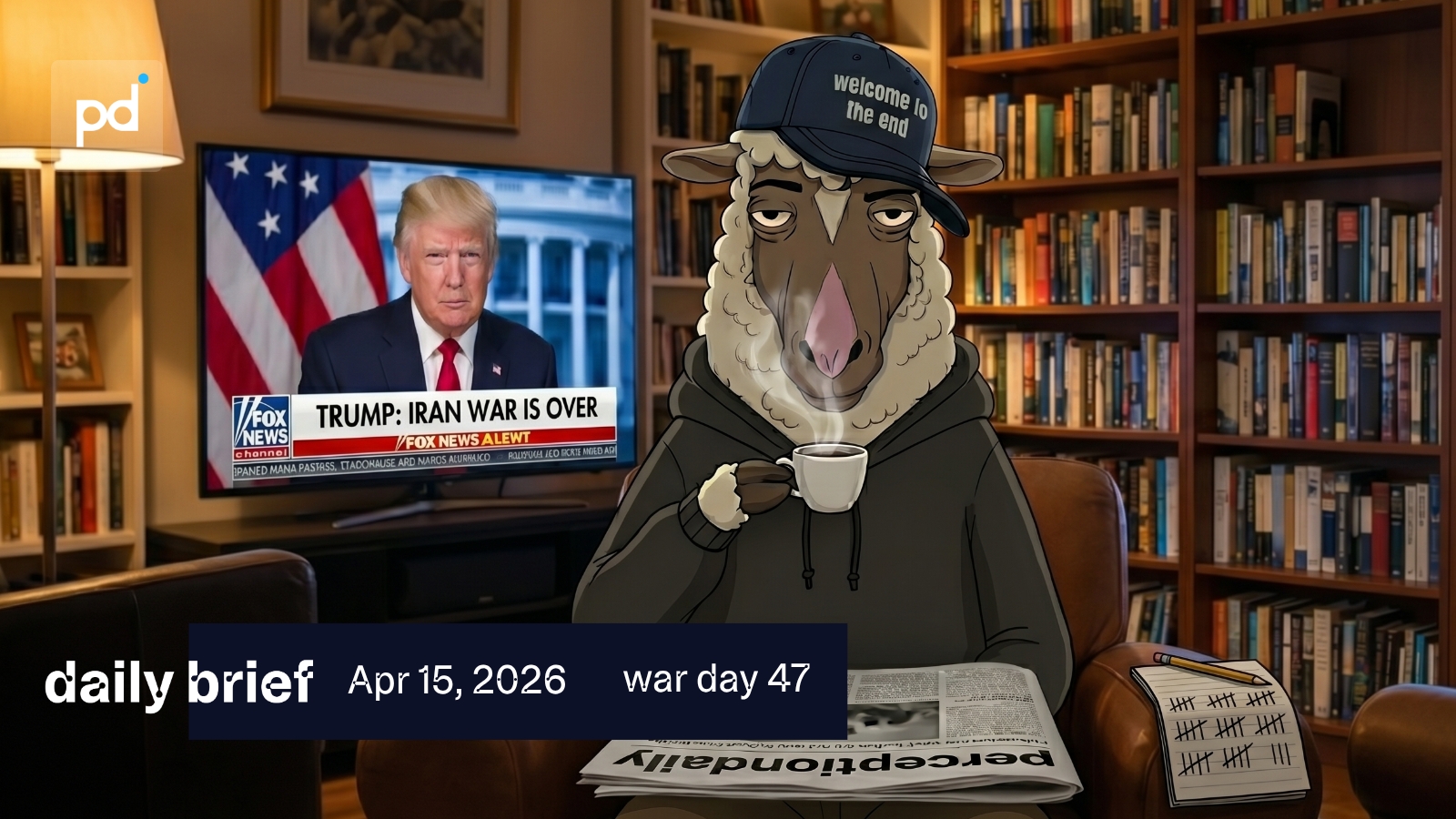
We are on day 47. The ceasefire expires on April 21. Six days left. And this Wednesday morning we find ourselves with a US naval blockade active on the Strait of Hormuz, Iran having officially rejected the American proposal to suspend its nuclear program for 20 years, and a second round of negotiations not yet scheduled — but one that everyone, from Washington to Islamabad to Tehran, seems to want to keep alive.
The picture is paradoxical. Trump announced the blockade as a response to the failure of the April 12 Islamabad talks — 21 hours of negotiations, no agreement. And yet, almost simultaneously, he said "something could be happening" within two days in Pakistan. Markets believed it: Brent crashed 8% in a single day, from above $103 to $94.79. The blockade is a pressure weapon, not a declaration of war. For now.
The real knot is nuclear. Both sides have proposed a suspension of uranium enrichment, but cannot agree on the duration. The US wants 20 years, Iran said no. Vance left Islamabad saying he had put a "best and final" offer on the table. Araghchi responded talking about "maximalism and shifting goalposts." And yet Pakistan is working to bring both delegations back to Islamabad by the weekend, with the goal of also extending the truce. Time is running out. The margin exists. But it is thin.
📍 MILITARY SITUATION
🔒 HORMUZ BLOCKADE — ACTIVE BUT NOT AIRTIGHT
The US blockade on all vessels entering and leaving Iranian ports has been operational since April 13. The US Navy has orders to intercept any ship that has paid tolls to Iran for transit through the Strait. However, one Iranian tanker managed to depart from an Iranian port and cross Hormuz despite the blockade.
🌡️ CALIBRATE: the blockade's effectiveness depends on what China does. Most Iranian tankers are headed for Beijing — and Washington does not appear willing to confront Chinese vessels.
🚀 IRANIAN MISSILES — THE SILENT RECONSTITUTION
Satellite imagery reveals that during the ceasefire Iran is digging to remove debris blocking the entrances to its underground missile bases. Around half of Iran's missile launchers are reportedly still intact. Vehicles are working to reopen the tunnels.
⬇️ YOU'RE UNDERESTIMATING IT: if the second round fails and war resumes, Iran will be in a far stronger missile posture than it was on April 8.
🇱🇧 LEBANON-ISRAEL — THE FRONT THAT COULD BLOW EVERYTHING UP
Israel and Lebanon met on Tuesday in Washington for the first direct talks since 1993. Result: agreement to "meet at a mutually agreed time and venue." Israel refused to commit to a ceasefire in southern Lebanon. Meanwhile Hezbollah fired rockets at 13 northern Israeli towns precisely as negotiators were at the State Department.
🌡️ CALIBRATE: the core problem is that the US-Iran ceasefire does not explicitly include Lebanon. As long as Israel bombs and Hezbollah responds, Tehran has a perfect diplomatic alibi to avoid signing.
🏥 US CASUALTIES — NEARLY 400 WOUNDED
399 US service members have been wounded in action since the start of the war. 354 have returned to duty. 3 are currently in serious condition. Traumatic brain injuries from blast exposure are emerging with delays in official reporting.
🔑 KEY DEVELOPMENT OF THE DAY
RUSSIA OFFERS TO TAKE IRAN'S URANIUM — AND ALMOST NOBODY IS TALKING ABOUT IT
Moscow has publicly repeated its offer to accept Iran's enriched uranium as part of a potential deal with the US. The Kremlin confirmed that Putin has already put this proposal to both Washington and regional states. It is a structural offer: it physically removes nuclear material from Iran, satisfies the American denuclearization demand, and gives Moscow a central role in the post-war order. If Tehran accepted, it could be the diplomatic trojan horse that unlocks the second round. The fact that no major Western outlet is treating it as the lead story of the day says everything about how underestimated it is.
☄️ DON'T LOOK UP
Today: Brent at $94.79 after an 8% drop. US average gas price at $4.12. European energy prices remain under pressure.
Within 30 days: If ceasefire expires April 21 without a deal, Brent returns above $100. European gas and electricity bills rise. Flights contract.
If Hormuz stays closed beyond May: IEA forecasts first global oil demand contraction since Covid. Recession in Middle East and East Asia. Europe in stagflation from a prolonged energy shock.
⚡ ENERGY & MARKETS
Brent (June contract) closed Tuesday at $94.79 after a -4% single-day drop on diplomatic hopes. WTI fell below $92 (-8%). On Monday Brent had hit $103 (+8%) following the blockade announcement. Volatility is at maximum: every Trump statement or Araghchi declaration moves the market by billions. The IEA warned the conflict could wipe out all global oil demand growth in 2026 — the first annual contraction since Covid. OPEC+ already recorded a production drop of 7.9 million barrels per day in March.
📊 PERCEPTION INDEX - SUMMARY
🔴 Second Islamabad round ............... ⬇️ More decisive than it seems — decided within 48h
🔴 Hormuz blockade ............... 🌡️ Pressure weapon, not a total closure — tankers still moving
🔴 Iran rejects nuclear proposal ............... 🌡️ No to duration, not to the principle — talks still alive
🔴 Iran rebuilding underground missiles ............... ⬇️ Nearly ignored — will shift the balance if war resumes
🔴 Russia offers to manage Iranian uranium ............... ⬇️ Structural proposal undervalued by Western media
🔴 Lebanon excluded from ceasefire ............... ⬆️ Symbolically explosive, but won't alone blow up the deal
🔴 IEA: first oil demand contraction since Covid ............... ⬇️ Macro data that will reshape the coming weeks
🎖️ PERCEPTION DEFCON INDEX
🔴 DEFCON 1 — Active War / Emergency Diplomacy
We are at the most critical moment since the start of the conflict. Not because the shooting has intensified — the ceasefire holds on the main front. But because the diplomatic window closes in six days. The blockade is active, Iran is rebuilding missile capacity, and the nuclear question remains unresolved. DEFCON does not drop until a second round is confirmed or the truce is extended.
Escalation triggers:
— Second round does not take place before April 21 → resumption of US-Israel military operations
— Chinese vessel intercepted by the US blockade → Washington-Beijing diplomatic crisis
De-escalation signals:
— Official announcement of a confirmed second Islamabad round with a set date
— Pakistan announces ceasefire extension of at least 7-10 days
perceptiondaily by thesmallmediacompany warfare intelligence. next brief: tomorrow at 7.00am.